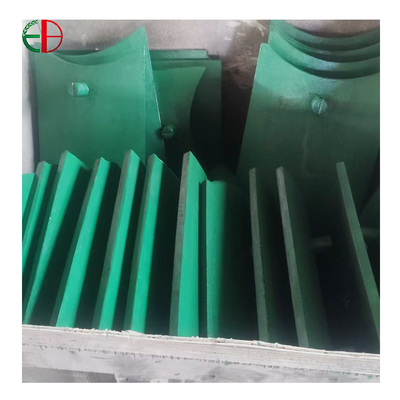
|
|
| MOQ: | 700kg |
| Price: | USD 1.6~4.0/kg |
| Standard Packaging: | Pallets |
| Delivery Period: | It depends on the quantity to be ordered. |
| Payment Method: | L/C,T/T,Western Union |
| Supply Capacity: | 10000 tons per year |
High chromium white cast iron hopper liners form a replaceable wear surface inside bulk-material handling equipment. A hopper combines sloping walls, transitions and an outlet, so its lining is a set of components with different positions and shapes. This product focuses on cast liners defined around those surfaces and the way material moves across them.
Incoming material can contact the hopper at an entry zone, slide along a wall and change direction near the outlet. Those locations may experience different wear patterns. A useful liner layout identifies the exposed surfaces and the boundaries between individual panels, rather than treating the whole hopper as one uniform plate.
For replacement work, photographs of wear and an equipment drawing help show where material is being lost. Wall angle, local profile and the relationship between adjacent pieces are part of the component geometry. The liner shape should follow the approved hopper design, including the intended openings and clearances.
High chromium white cast iron is selected for abrasive applications, with the exact alloy and delivery condition defined for the service. Hard carbide-containing structures support wear resistance, while impact severity and the supporting arrangement also need consideration. The grade choice should follow the actual handled material and duty.
Useful operating details include feed size, moisture, flow direction and the location where material first strikes the lining. A hopper carrying fine abrasive material may present different demands from one receiving large lumps. These differences make a single calendar service-life figure unsuitable for every installation.
Each panel drawing should show its overall profile, thickness, mounting locations and installation position. Adjacent edges and transitions need to match the liner layout. Fixing details should be specified together with the available support and access for installation.
The sand-cast component is supplied with shot-blast surface cleaning as listed for this product. Any additional finished surfaces or special fixing geometry are defined in the drawing. Bolts or other installation items should be identified in the quotation where they form part of the requested supply.
A numbered layout helps distinguish side-wall, transition and outlet pieces during receiving and installation. For a repeat order, include the previous part references and any approved drawing changes. Recording the wear pattern by location can also help the maintenance team plan which pieces need replacement.
Dimensional inspection addresses the panel profile and fixing positions. Material and hardness acceptance follow the selected grade specification, with required records agreed for the order. This connects the component received by the customer to both its wear duty and its position in the hopper.
| Parameter | Product specification |
|---|---|
| Material | High chromium white cast iron; grade to the approved specification |
| Product form | Custom hopper liner panel |
| Manufacturing process | Sand casting |
| Surface cleaning | Shot blasting |
| Dimensions | Drawing-defined profile, thickness and installation dimensions |
| Mounting | Fixing-hole pattern and seating geometry to the approved drawing |
| Hardness and condition | Selected grade specification and agreed test method |
| Inspection | Drawing dimensions and order-specified material records |
Line the wear zones, not just the walls. Send EB Castings your hopper layout, liner drawings and handled-material details for a custom high chromium cast iron liner quotation.
Product enquiries: cast@ebcastings.com or ebcastings@163.com.
The process chart illustrates the casting workflow; the NEWCAST banner is a historical exhibition reference from 2015. Product shapes are shown in the gallery above.
![]()
![]()
![]()
![]()
|
|
| MOQ: | 700kg |
| Price: | USD 1.6~4.0/kg |
| Standard Packaging: | Pallets |
| Delivery Period: | It depends on the quantity to be ordered. |
| Payment Method: | L/C,T/T,Western Union |
| Supply Capacity: | 10000 tons per year |
High chromium white cast iron hopper liners form a replaceable wear surface inside bulk-material handling equipment. A hopper combines sloping walls, transitions and an outlet, so its lining is a set of components with different positions and shapes. This product focuses on cast liners defined around those surfaces and the way material moves across them.
Incoming material can contact the hopper at an entry zone, slide along a wall and change direction near the outlet. Those locations may experience different wear patterns. A useful liner layout identifies the exposed surfaces and the boundaries between individual panels, rather than treating the whole hopper as one uniform plate.
For replacement work, photographs of wear and an equipment drawing help show where material is being lost. Wall angle, local profile and the relationship between adjacent pieces are part of the component geometry. The liner shape should follow the approved hopper design, including the intended openings and clearances.
High chromium white cast iron is selected for abrasive applications, with the exact alloy and delivery condition defined for the service. Hard carbide-containing structures support wear resistance, while impact severity and the supporting arrangement also need consideration. The grade choice should follow the actual handled material and duty.
Useful operating details include feed size, moisture, flow direction and the location where material first strikes the lining. A hopper carrying fine abrasive material may present different demands from one receiving large lumps. These differences make a single calendar service-life figure unsuitable for every installation.
Each panel drawing should show its overall profile, thickness, mounting locations and installation position. Adjacent edges and transitions need to match the liner layout. Fixing details should be specified together with the available support and access for installation.
The sand-cast component is supplied with shot-blast surface cleaning as listed for this product. Any additional finished surfaces or special fixing geometry are defined in the drawing. Bolts or other installation items should be identified in the quotation where they form part of the requested supply.
A numbered layout helps distinguish side-wall, transition and outlet pieces during receiving and installation. For a repeat order, include the previous part references and any approved drawing changes. Recording the wear pattern by location can also help the maintenance team plan which pieces need replacement.
Dimensional inspection addresses the panel profile and fixing positions. Material and hardness acceptance follow the selected grade specification, with required records agreed for the order. This connects the component received by the customer to both its wear duty and its position in the hopper.
| Parameter | Product specification |
|---|---|
| Material | High chromium white cast iron; grade to the approved specification |
| Product form | Custom hopper liner panel |
| Manufacturing process | Sand casting |
| Surface cleaning | Shot blasting |
| Dimensions | Drawing-defined profile, thickness and installation dimensions |
| Mounting | Fixing-hole pattern and seating geometry to the approved drawing |
| Hardness and condition | Selected grade specification and agreed test method |
| Inspection | Drawing dimensions and order-specified material records |
Line the wear zones, not just the walls. Send EB Castings your hopper layout, liner drawings and handled-material details for a custom high chromium cast iron liner quotation.
Product enquiries: cast@ebcastings.com or ebcastings@163.com.
The process chart illustrates the casting workflow; the NEWCAST banner is a historical exhibition reference from 2015. Product shapes are shown in the gallery above.
![]()
![]()
![]()
![]()